When a pattern gets overlooked
Jordan feels lightheaded while waiting in line and notices that sitting changes how they feel. A coworker wonders whether it is stress.
A fast or pounding heart, dizziness, and feeling very tired can each have several causes. A doctor can help find out what is happening, even if you already have POTS.
Call 911 in the U.S. or your local emergency number if you have chest pain, trouble breathing, or pass out with a racing or pounding heart. Call right away if someone passes out and does not wake up quickly. Follow the dispatcher’s directions.
MedlinePlus emergency signsCall if you pass out and recover, or if your heart starts racing or pounding in a new or different way. Tell the office what happened and ask how soon you should be seen. Use emergency help if you have any of the signs above.
MedlinePlus guidance on a racing or pounding heartMake an appointment if you often feel dizzy, very tired, or feel your heart race when you stand. Tell your doctor if sitting or lying down helps, or if the symptoms get in the way of school, work, or daily tasks.
Johns Hopkins Medicine overview of POTSThe Role of Stress, Inflammation, and Depression in Postural Orthostatic Tachycardia: A Psychoneuroimmunology Perspective by Tawana McCou, MS.
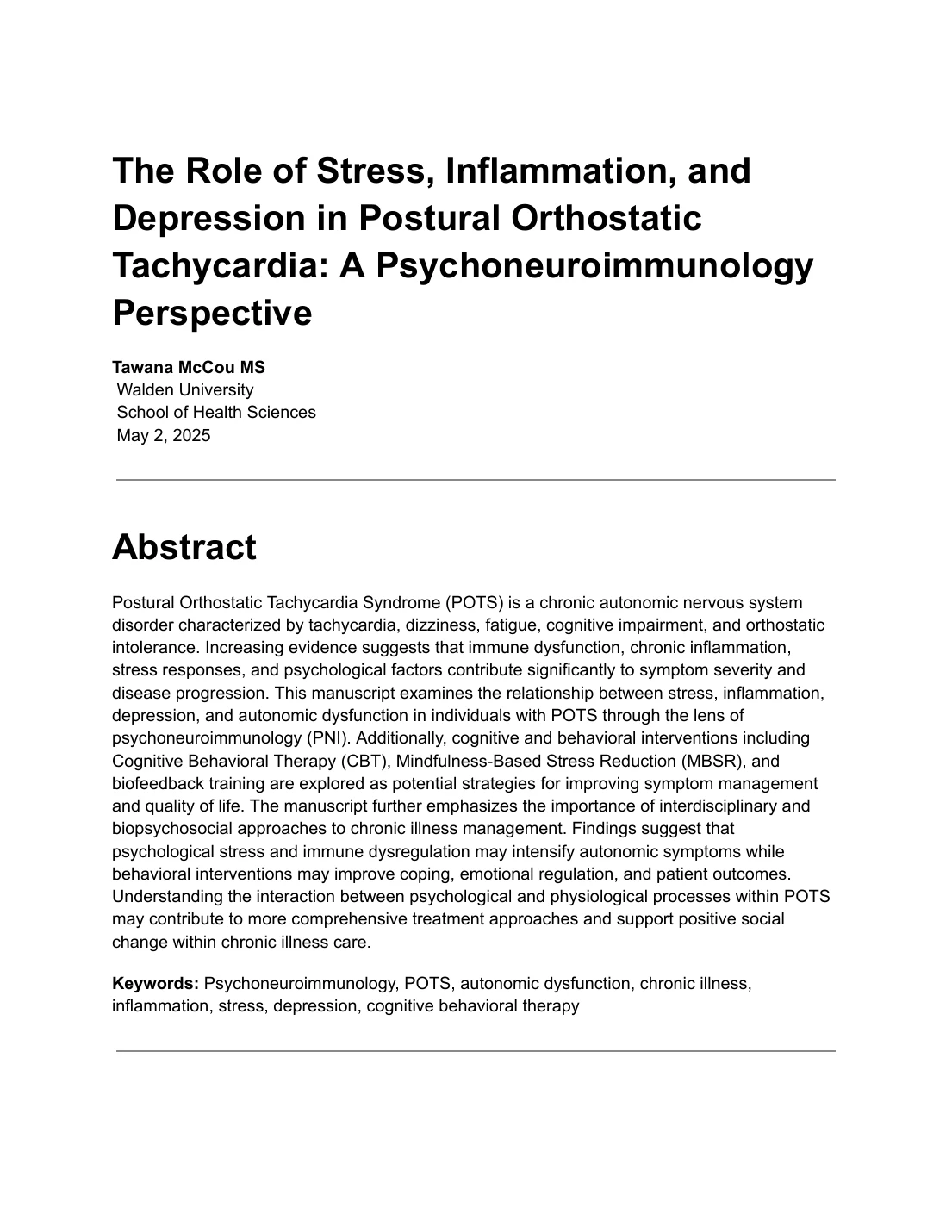
Postural orthostatic tachycardia syndrome (a condition that can make your heart beat much faster when you stand) (POTS) is a chronic (long-lasting) disorder involving autonomic regulation (how your body controls jobs like your heartbeat on its own). People may experience a marked rise in heart rate and symptoms such as lightheadedness or palpitations (feeling your heart race, pound, or flutter) when upright. Fatigue (feeling very tired) and difficulty concentrating can affect work, school, and social life. Clinicians evaluate the overall pattern and consider other possible explanations. Clinical sources
Psychoneuroimmunology (the study of how your mind, nerves, and body’s germ-fighting system work together) (PNI) studies relationships among psychological processes, the nervous system, and immune function (how your body fights germs). McCou uses it as a lens for exploring how these processes may interact in POTS.
The manuscript is a narrative literature review (a paper that brings together ideas and findings from other studies). It brings together findings across several topics and proposes ways to interpret their relationships. When studies report that two factors occur together, ask how each was measured, which occurred first, and what other explanations the study considered.
The review discusses cognitive behavioral therapy (talk therapy that helps you practice new ways to think and act), mindfulness-based stress reduction (a program that uses quiet practice to pay attention and handle stress), and biofeedback (practice using a device to see and learn about body signals like your heartbeat) as possible supports for coping and quality of life (how well you feel and manage daily life). In a coordinated care discussion, a person can raise concerns about physical symptoms, emotional strain, and barriers to daily activities. Each concern deserves attention on its own terms.
These fictional cases are for education and discussion.
Jordan feels lightheaded while waiting in line and notices that sitting changes how they feel. A coworker wonders whether it is stress.
Amira has diagnosed POTS. She has begun turning down invitations because she cannot predict how long she will be able to stay, and she misses seeing friends.
A headline says a study found an association between an inflammatory marker (a clue found in a body sample that may point to inflammation) and symptom severity in a small POTS sample.
Use this worksheet for a class discussion or to organize questions for a healthcare visit. Use hypothetical or de-identified notes. Entries save in this browser when storage is available.
McCou, T. (2025, May 2). The Role of Stress, Inflammation, and Depression in Postural Orthostatic Tachycardia: A Psychoneuroimmunology Perspective [Narrative literature review]. Walden University, School of Health Sciences.
Educational companion. Discuss individual diagnosis and care with a qualified clinician. Cover image is an AI-generated illustration.